Minnesota Becomes the Third State to Vote Through a Psilocybin Therapy Program
The House just advanced a federally-funded clinical pathway — what the Minnesota bill actually does, how it differs from Oregon and Colorado, and what happens between St. Paul and the FDA next.
On May 8, 2026, the Minnesota House of Representatives passed a bill to create the state's first medical psilocybin program. If the Senate concurs, Minnesota will join Oregon (2020) and Colorado (2022) as the third state in the country to authorize supervised therapeutic use of a Schedule I psychedelic.
It is the most consequential psilocybin vote in the Upper Midwest to date — and the cleanest legislative win so far this decade, because the program rides on top of federally-funded clinical research rather than building a private services market from scratch.
Why a House floor vote, not a ballot initiative
Oregon's program was created by Measure 109, a 2020 ballot initiative. Colorado's Natural Medicine Health Act was Proposition 122 in 2022. Minnesota's path is different: a bill, sponsored in the House and tracking through legislative committees rather than the petition system. Lawmakers, not voters, made the call.
That distinction matters for two reasons. First, ballot programs in other states have moved faster but also collected more political baggage — the regulatory rule-making in Oregon took two years and required several legislative cleanups before the first licensed session in 2023. Bills can be tighter and easier to amend. Second, a legislative vote is a signal about where the median Minnesota legislator now sits. Five years ago, this bill would not have cleared committee.
What the program actually does
The structure approved by the House is narrower than what most headlines suggest, and that's deliberate. The program is built around three pillars:
- Federally-funded research, not retail. The bill authorizes clinical research and supervised therapeutic administration, paid for in part through federal study funding. There is no equivalent of Oregon's licensed service centers open to the general public.
- Clinician-led sessions. Administration happens in a supervised clinical setting under a licensed practitioner — typically working with patients who carry treatment-resistant depression, PTSD, or end-of-life anxiety diagnoses.
- A sunset clause. The program is designed to expire on a fixed date unless lawmakers renew it. Sunset language is the legislative equivalent of an off-switch: it forces the legislature to look at the data before extending.
What the bill does not do is decriminalize possession for everyday use, authorize cultivation outside the program, or create a Colorado-style "natural medicine healing center" framework. Minnesota is choosing the narrow door first.
Three states with state-level psilocybin programs is not yet a national reform — but the federally-funded research framing is the piece other state legislatures can copy without taking the political risk of a ballot fight. The Minnesota template is the conservative on-ramp the rest of the country has been waiting for.
Veterans, suicidality, and the room where the bill moved
The political coalition behind the bill is the same one that has moved every successful psilocybin vote in the United States: clinicians, veterans, and families who lost someone to suicide. Testimony in St. Paul leaned heavily on the data emerging from trials for chronic suicidal ideation and treatment-resistant depression.
The reason this bill moved is not because legislators woke up curious about psychedelics. It moved because the people testifying weren't activists. They were nurses, ex-Marines, and parents.
That is also why the bill landed on the conservative end of the policy spectrum. Federally-funded clinical pathways, sunset clauses, and a tight diagnostic gate are the kinds of guardrails that bring along senators who would never vote for a Colorado-style ballot measure.
What about the strains — and the science behind them
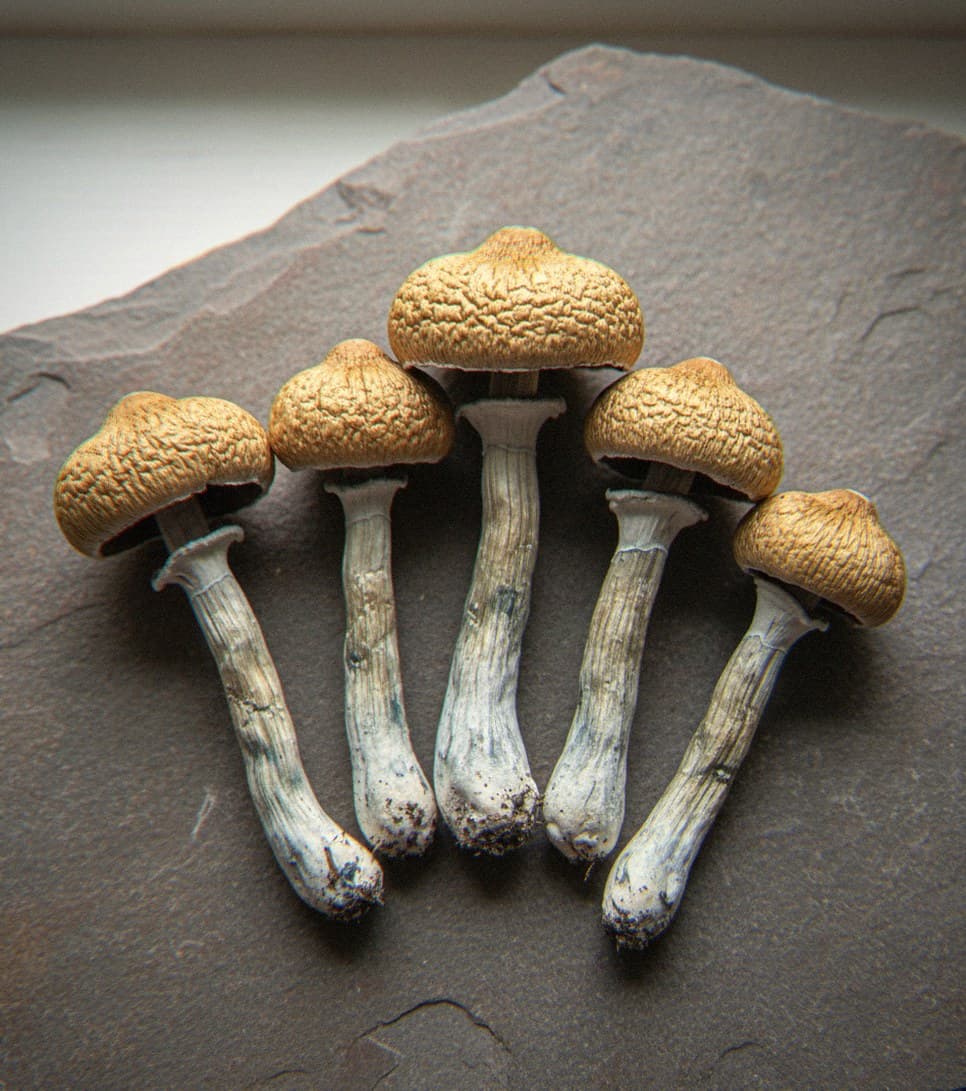
Therapeutic programs do not run on whatever variety happens to be available; they run on standardized, lab-grown Psilocybe cubensis with documented potency. The strains most frequently discussed inside clinical and harm-reduction circles for beginner-tolerant doses are the ones with the longest track record of consistency: the classic Golden Teacher and B+ — both Moderate-potency cubensis varieties bred for reliable fruiting and predictable effects rather than peak intensity.
The eventual Minnesota program will, like Oregon's, use one of a small number of facilitator-grade lots produced under state inspection. The cultivar question is less interesting than the dose, the protocol, and the integration support around the session — which is where the science actually lives.
What happens next
The bill heads to the Minnesota Senate, where the politics are tighter. If the Senate concurs, the program will need rulemaking — a process that took Oregon's Health Authority the better part of two years and Colorado's Department of Regulatory Agencies most of one. Realistically, the first Minnesota patient under the new program would sit down in 2027 at the earliest.
Watch for three things between now and then:
- Will the Senate version preserve the federally-funded research framing, or pivot toward a Colorado-style services market? The two paths produce very different programs.
- Will the Governor's office signal a position? Executive support shortens rulemaking by months.
- Will the legislature fund the rulemaking? An unfunded program is a program that doesn't open on time.
Minneapolis and St. Paul will be where the action lives — Twin Cities health systems and the University of Minnesota are the closest thing to a built-in clinical research backbone the state has. Outstate, expect counties along the Iron Range and in the southeast to watch closely; veteran density and behavioral health gaps make them likely first-cohort sites.
The bigger picture
Three states with active state-level psilocybin programs is not yet a national reform. But the pattern matters: each state is taking a slightly different shape. Oregon went service-center-first. Colorado went natural-medicine-healing-center. Minnesota is going clinical-research-first. The country is, in effect, running three policy experiments in parallel, with different gatekeepers, different patient pipelines, and different cost structures.
Whichever model holds up will be the template the next dozen states copy. If you are watching the federal trajectory of psilocybin — and the FDA's slow approach to any psychedelic therapy — Minnesota's bill is more interesting than its size suggests. It is the first state program designed from day one to feed federal research, rather than to operate around it.